

INGREDIENT COSTS & SELLING PRICES
Know the cost of each portion before setting its price.
Ingredient costing adds up the ingredients actually used in a recipe, then divides the total by the number of portions. COSTING links purchase prices to your recipes so you can compare cost per portion, selling price and food cost ratio.
No bank card needed for the trial · Limits and plans shown on the home page
How do I calculate a recipe’s ingredient cost?
For each ingredient, use a price and quantity in compatible units. Multiply the quantity used by the corresponding unit price, then add the lines. Divide the total by the number of portions. Base recipes, conversions and yields must be consistent for the result to be useful.
Understand food cost ratio, margin and multiplier
Food cost ratio is ingredient cost excluding VAT divided by selling price excluding VAT, multiplied by 100. Ingredient margin in value is the difference between these amounts. The excluding-VAT multiplier is selling price divided by ingredient cost. Always compare amounts on the same VAT basis.
Choose a price using your own figures
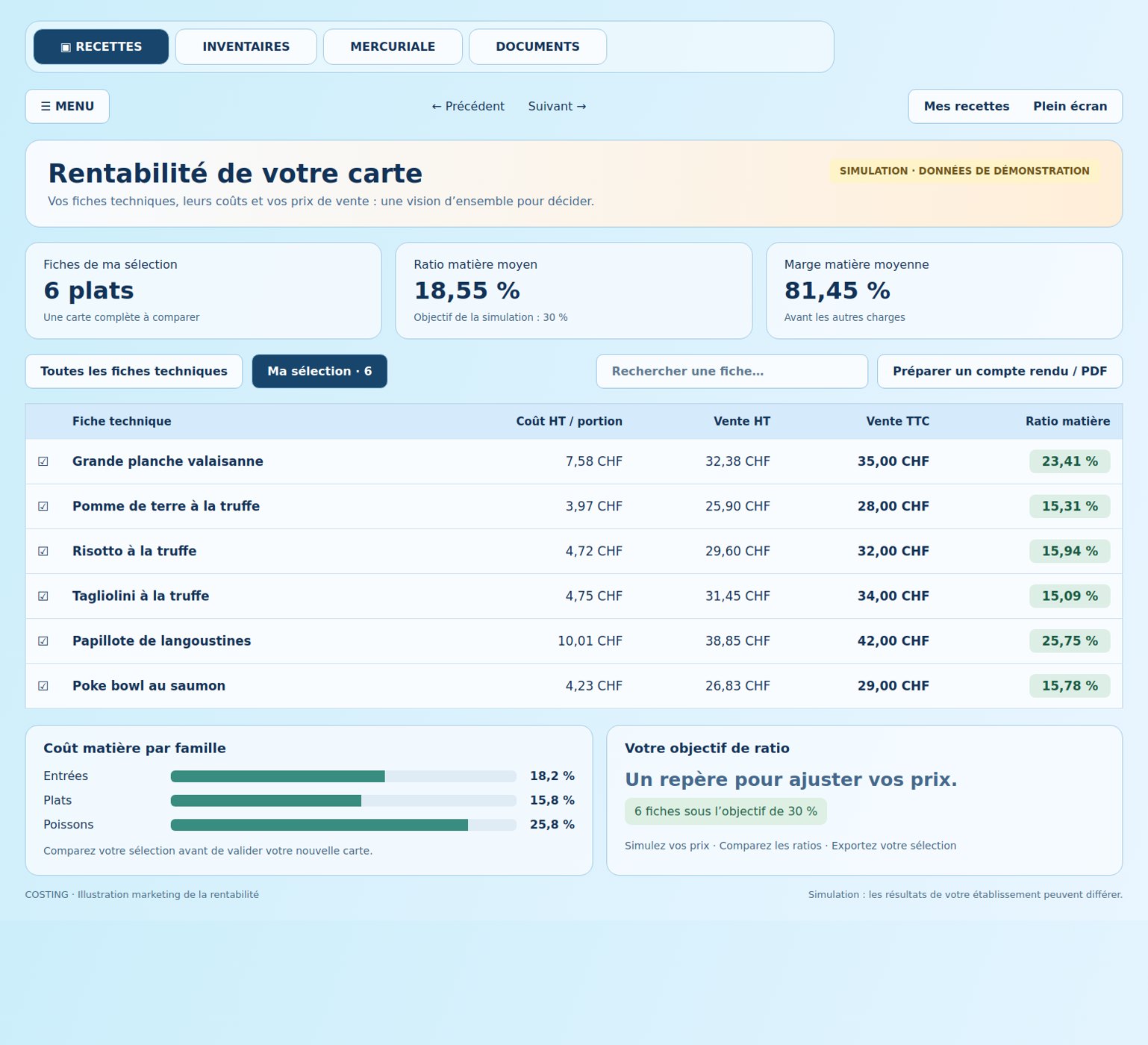
In COSTING’s Profitability section, compare production costs, entered selling prices, food cost ratio, margin and multiplier. These figures help you review your menu. They do not set prices for you: positioning, overheads and customers still matter.
How do I get started with COSTING?
Check purchases
Check each product’s price excluding VAT, unit and quantities.
Calculate the portion
Add ingredients and preparations, then divide the total.
Compare prices
Review food cost ratio and ingredient margin using a consistent selling price excluding VAT.
A PRACTICAL EXAMPLE
Example: €6 of ingredients for a dish sold at €20 excluding VAT
With ingredient cost of €6 excluding VAT and a selling price of €20 excluding VAT, the ratio is 30%: 6 ÷ 20 × 100. Ingredient margin is €14 excluding VAT, or 70% of the selling price excluding VAT. The multiplier is about 3.33: 20 ÷ 6. These three indicators describe the same dish from different angles.
Fictional educational example. The €14 ingredient margin is not net profit: salaries, rent, energy and other expenses still need to be covered.
Practical questions
What food cost ratio should a restaurant aim for?
There is no universal figure for every business. Your target depends on your activity, overheads, menu and positioning. COSTING lets you work with your own benchmarks.
Should I use selling price including or excluding VAT?
To compare ingredient costs excluding VAT with a selling price, use the selling price excluding VAT. Mixing amounts including and excluding VAT distorts the ratio.
What happens when a supplier price increases?
Once the purchase price is updated in the Price List, COSTING recalculates costs for recipes and preparations that use the product.
Try COSTING with your own recipes and products.
Discover your culinary management workspace, then choose the plan that suits your kitchen.